
Progressing on net zero
We believe in measurable goals and objectives to drive climate action. Our science-based net zero targets align with the latest climate science to limit global warming to 1.5°C and drive meaningful change in our industry. Our science-based targets for achieving net zero emissions by fiscal year 2041, approved by the Science Based Targets initiative (SBTi), are a testament of our commitment to sustainable business practices and to reducing our environmental impact, at an accelerated pace.
High ambitions: our targets
As a first step, we defined our baseline (fiscal year 2023), i.e. what do we emit every year. This resulted in a programme that will help us to reach net zero. Our target is to reach net zero across our value chain by fiscal year 2041. The largest part of fiscal year 2041 lies in calendar year 2040, so this puts Toyota Material Handling Europe in the lead when it comes to climate ambitions.

- 0%
of scope 1 & 2 by FY2031
- 0%
of scope 3 by FY2031
- 0%
of scope 1, 2 & 3 by FY2041
What does all this mean for our customers, our partners and our suppliers?
Decarbonisation has become one of the focus points for companies across Europe to limit global warming to 1.5°C. What binds us together is our shared responsibility and commitment to achieve net zero. In fact, as a supplier, we are fully engaged in reaching the SBTi targets, helping other companies to reduce their emissions. This means total transparency and an uncompromising commitment for our entire value chain.
Klientai
Mūsų klientai ieško patikimų, užtikrintų partnerių, kurie yra įsipareigoję siekti mokslu pagrįstų tikslų, gali pateikti savo įrangos anglies dioksido išmetimo į aplinką įvertinimus ir imasi konkrečių veiksmų, kad sumažintų šį išmetimą įvairiais gyvavimo etapais. Mes teikiame pirmenybę 6 pagrindinėms sritims, kad iki 2041 finansinių metų pasiektume nulines emisijas, pateikdami aiškų ir konkretų veiksmų planą.
Tiekėjai ir partneriai
Tiekėjai sudaro 30 % mūsų bendro anglies dioksido pėdsako (3 lygis – tiekimo grandinė). Todėl bendradarbiavimas su jais yra būtinas, kad galėtume pasiekti savo anglies dioksido išmetimo mažinimo tikslus. Pradėjome bendradarbiauti su tais tiekėjais, kurie yra svarbūs klimato veiksmams, kad jie įsipareigotų laikytis SBTi ir dalytųsi anglies dioksido duomenimis. Taip pat tiriam naujoviškus būdus, kaip sumažinti anglies dioksido intensyvių žaliavų ir baterijų pėdsaką. Be tiekėjų, mūsų logistikos partneriai taip pat raginami taikyti alternatyvius sprendimus, kad sumažintų transporto priemonių išmetamą CO2 kiekį.

Lower-emission products
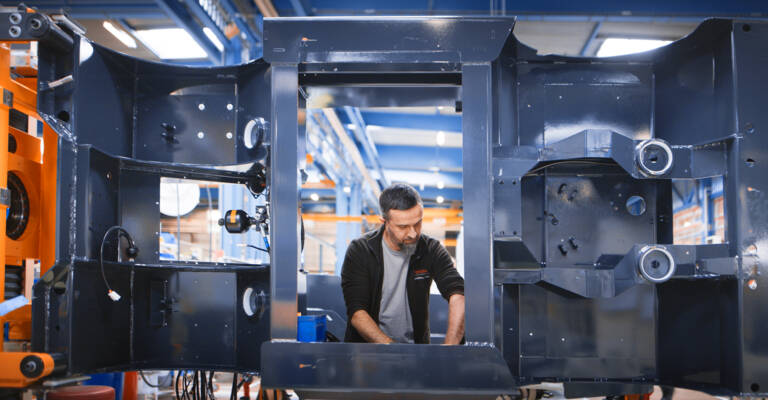
We are the first material handling equipment manufacturer to integrate recycled steel made from fossil-free energy into our product range.
By reducing the reliance on traditional steel making from virgin raw materials, we lower the carbon footprint of the materials used to build our trucks while maintaining the same strength and durability that you expect.

Suppliers & partners
Suppliers represent 30% of our total carbon footprint (Scope 3 - upstream). Engaging with them is therefore essential for us to meet our carbon reduction targets. We started engaging with those suppliers critical to climate action to have them commit to the SBTi and share carbon data.
We are also investigating innovative ways to reduce the footprint of carbon intensive raw materials and batteries. Besides our suppliers, our logistic partners are also being urged to adopt alternative solutions to lower CO2 emissions from transport.
Reaching our SBTi targets is a team effort
To reach our ambitious targets we have a dedicated net zero team that, together with colleagues from the entire organisation and — to date — well over one hundred of our customers and 88 of our strategic suppliers, focusses on five areas. Find out where we are today.

Our action plan
Five focus areas of our decarbonisation strategy
The first area focuses on our Scope 1 & 2 emissions. The remaining areas address our Scope 3 emissions.
Specifically, the second and third area target materials, which account for 23.6% of our emissions.
The fourth area addresses use phase emissions, representing 66.7% of our emissions, while the fifth area focuses on transport, which makes up 8% of our emissions.

Scope 1 & Scope 2
Action 1: Reach net zero in own operations
Ensure all energy used is net zero and improve energy efficiency:
- zero emission vehicles
- net zero in factories, sales companies & warehouses
- 100% green electricity

Scope 3
Action 2: Reduce material emissions
Focus on the two main materials with the highest CO2e intensity:
- transition to recycled and green steel
- transition to battery technology with low CO2e

Scope 3
Action 3: Circularity
Improve eco-design and truck lifetime:
- use of recycled materials & parts
- extend lifespan

Scope 3
Action 4: Reduce use‑phase emissions
Collaborate with customers to switch to low carbon energy sources:
- next generation truck design
- green electricity
- increase energy efficiency

Scope 3
Action 5: Lower logistics emissions
Optimise logistics solutions:
- low carbon transport
- biofuel and electrical vehicles
Science Based Targets initiative
“A carbon emission target is defined as science-based if it is consistent with the level of decarbonisation that, according to climate science, is required to keep global temperature increase within well-below 2°C, and ideally 1.5°C compared to pre-industrial levels”
What is the SBTi and why set targets?
The Science Based Targets initiative (SBTi) is the leading organisation that helps companies define GHG emission reduction targets and assesses their scientific validity. The SBTi is a collaboration between the CDP, the United Nations Global Compact, World Resources Institute and the World Wide Fund for Nature. *
By validating greenhouse gas emission reduction targets companies have set against the latest scientific recommendations, the SBTi provides a science-based framework and guidelines for companies to set targets that are in line with the latest climate science, targets required to limit the most dramatic impacts of climate change as opposed to arbitrary targets.
To enable companies to set ambitious and meaningful reduction targets, the SBTi also provides industry-specific guidance, calculation tools, and other resources.
More about companies taking action & the Science Based Targets Initiative >
* Carbon Disclosure Project (CDP) – NGO that provides a global system for companies and cities to measure, disclose, manage and share environmental information
* United Nations Global Compact – the world's largest corporate initiative based on CEO commitments to implement universal sustainability principles and take steps to support UN goals
* World Resources Institute (WRI) – global research organisation in the fields of environment and socio-economic development
* WWF – independent nature conservation organisation
The scopes
Scopes are defined by the Greenhouse Gas Protocol (GHG Protocol). These carbon accounting scopes make it possible to categorise a company's GHG emissions according to their origin and their direct or indirect control. This forms the basis of an effective emissions management and reduction strategy.

Definitions & FAQ
What is SBTi?
The Science Based Targets initiative (SBTi) provides companies with a clearly defined path to reduce emissions in line with the Paris Agreement goals. More than 6,000 businesses around the world are already working with the SBTi.
Why is net zero important?
To reach net zero, we need to make sure that the carbon dioxide we release into the air is balanced by the amount we remove. This balance will help stop the increase of greenhouse gases in the atmosphere.
Achieving net zero means we have to completely change how we produce and use energy, how we transport materials and how we make and consume goods. These changes are crucial to prevent the worst effects of climate change.
What is a company’s baseline?
A baseline is a reference point (year) used for comparison towards SBTi.
Is it mandatory to set net zero targets?
It is not. However, companies that committed to the SBTi on or after 15 July 2022 are required to use Version 5 of the criteria which requires alignment with a 1.5°C-pathway for most companies.
Are Toyota Material Handling Europe’s targets approved by SBTi?
Yes, they are.
What are Toyota Material Handling Europe’s sbti targets?
On March 27, 2024, the SBTi has validated the science-based greenhouse gas emissions target(s) submitted by Toyota Material Handling Europe AB conform with the SBTi Corporate Net Zero Standard. Our target is to reach net zero across our value chain by fiscal year 2041.
Read our Sustainability report >
Quick links